Two seal point Siamese, mated together, can produce a litter with blue, chocolate and lilac kittens — and not one seal among them. If that sounds like magic, it isn’t. It’s genetics, and once you can see the handful of genes at work behind every Siamese coat, the whole thing stops being mysterious and starts being something you can plan.
This is the beginner’s guide to Siamese cat colour genetics I wish I’d had when I registered my first litter. No biology degree required. By the end you’ll understand why every Siamese is pointed, how a kitten inherits its colour from both parents, what it means when a cat “carries” a colour it doesn’t show, and how to read a pairing before the kittens ever arrive. It’s written for new and prospective breeders, but curious owners are very welcome — everyone leaves knowing more than they came with.
Think of this page as the map. Each gene below has its own step-by-step lesson, and the whole course ends with a tool that does the colour maths for you. Let’s start with the single idea that unlocks everything else.
You can put all of this into practice with our free breeder tools.
What colour genetics actually means (the 60-second version)
Every cat has two versions of each colour gene — one inherited from its mother, one from its father. The combination it carries is its genotype. What you actually see in the coat is its phenotype. Those two things are not the same, and the gap between them is where all the surprises live.
A gene can be dominant (it shows even if the cat has only one copy) or recessive (it only shows if the cat has two copies, one from each parent). A cat can therefore carry a recessive colour completely hidden, then pass it on. Mate two cats that each secretly carry the same recessive, and roughly a quarter of the kittens can show a colour neither parent displays.
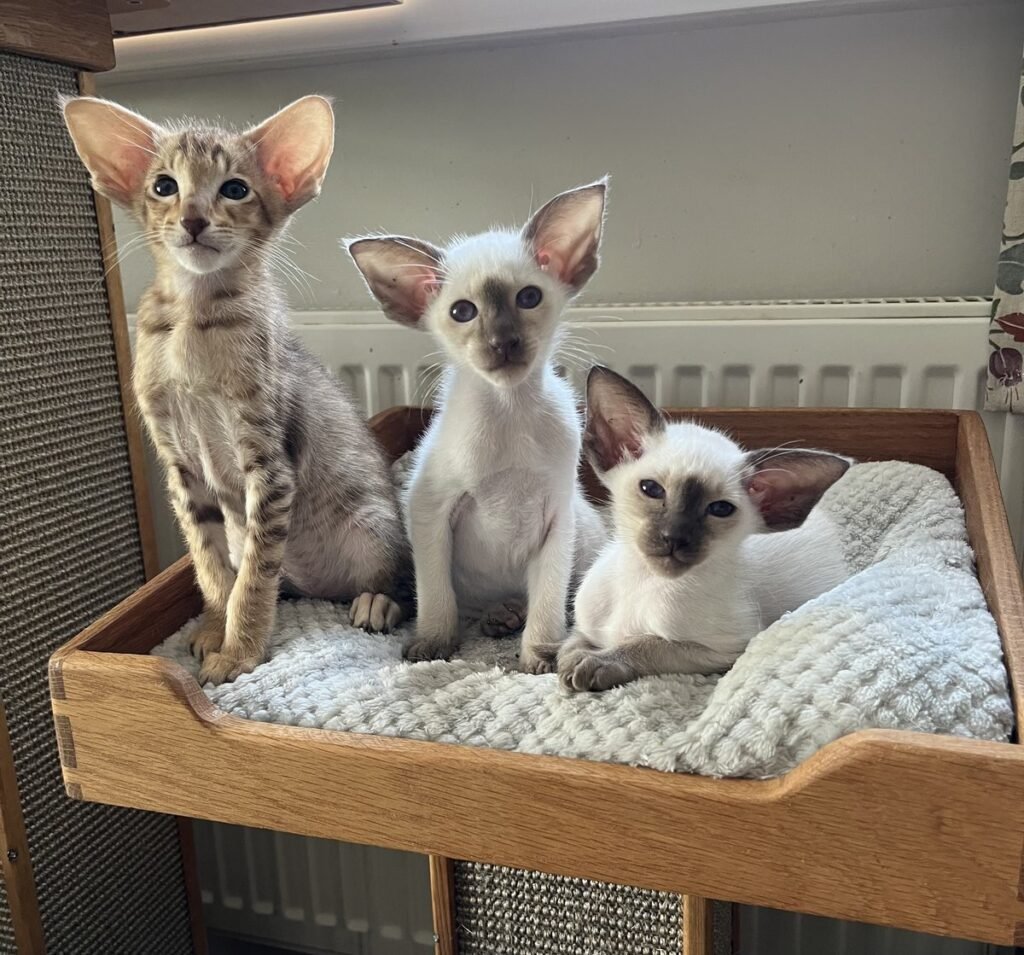
That’s the whole trick. Seal points carrying chocolate and dilute can produce blue, chocolate and lilac kittens because those hidden recessives finally meet. Understand dominant, recessive and carrying, and you understand most of cat colour. Everything below is just which genes do what.
Why every Siamese is “pointed” first
Before any colour question, there’s the thing that makes a Siamese a Siamese: the points. The dark ears, mask, legs and tail on a pale body aren’t a colour in their own right — they’re a pattern laid over whatever colour the cat would otherwise have been.
This is caused by a gene at the C locus, the Siamese version written cs. It produces a form of temperature-sensitive partial albinism. The enzyme that makes pigment, tyrosinase, simply doesn’t work properly at the cat’s warm core body temperature — but it switches on in the cooler extremities. So pigment develops on the ears, face, paws and tail, and the warm body stays pale. The same gene is why Siamese have those striking blue eyes.
The pattern is recessive: a cat needs two copies (cs/cs) to be a true Siamese point. Siamese kittens are born almost pure white, because the womb is uniformly warm; their points only emerge over the following weeks as they meet cooler air. And a Siamese shaved for surgery will often grow the fur back darker over the cool, clipped patch — temporary, harmless, and a neat live demonstration of the gene at work.
The full mechanism — tyrosinase, why points darken with age, and what happens when a Siamese carries only one copy — is covered in the lesson on the colourpoint gene.
The building blocks — how kittens inherit colour
Here’s the rule that does the heavy lifting: a kitten gets one copy of each colour gene from each parent, picked at random. That randomness is why two littermates from the same pairing can look different, and why you predict litters in probabilities, not certainties.
Take a worked example. A seal point that carries chocolate has one “seal/black” gene and one hidden “chocolate” gene. Mate it to another seal point that also carries chocolate, and each kitten independently draws one base-colour gene from each parent. On average, three in four kittens will look seal (they inherited at least one dominant black gene) and one in four will be chocolate (it drew the hidden recessive from both parents). None of this shows in the parents — it’s carried, invisible, until the two recessives meet.
“Carrying” is the single most useful concept in practical breeding. It’s why pedigree research and test matings matter, and why a good record-keeping system pays for itself. The full beginner walk-through — dominant versus recessive, how to spot a carrier, and simple ratios you can do in your head — is in the lesson on how cat coat colour is inherited.
The colours, gene by gene
Every Siamese colour comes from stacking a few independent genes on top of the point pattern. Here’s the map — a short tour of each, with a link to the Siamese colour chart so you can put a face to each name.
Base colour — seal, chocolate and cinnamon
The B locus sets the underlying pigment. The dominant version gives black, which on a pointed cat shows as the rich dark brown we call seal. Two recessive copies give chocolate (a warm milk-brown), and a third, even more recessive version gives cinnamon (a lighter, warmer reddish-brown). Black is dominant over chocolate, which is dominant over cinnamon — so seals routinely carry chocolate or cinnamon without showing it. Full detail, including which colours carry which, is in the lesson on base colour: seal, chocolate and cinnamon.
Dilution — blue, lilac and fawn
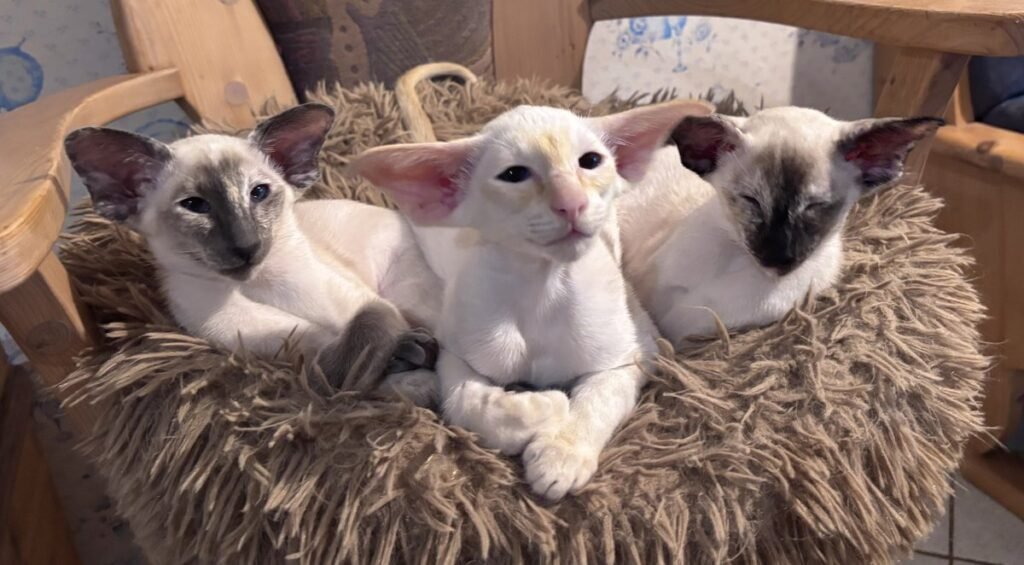
The D locus decides how densely that pigment is laid down. Two recessive copies (dd) give dilution, which softens every base colour into a paler partner: seal becomes blue (a cool grey), chocolate becomes lilac (a pinkish dove-grey), and cinnamon becomes fawn (a soft mushroom). Dilution is why a “grey” Siamese is really a blue point, and why two dense-coated parents that both carry dilute can produce dilute kittens. See the lesson on dilution: blue, lilac and fawn.
The caramel modifier — caramel and apricot
The dilute modifier (Dm) only acts on cats that are already dilute, shifting a dilute coat towards a cooler, metallic tone: blue, lilac and fawn all move towards caramel, and cream (dilute red) moves towards apricot. No modifier shows on a dense cat at all. These are rare, GCCF-recognised colours that most general guides skip entirely. See the lesson on the caramel modifier: caramel and apricot.
Red and tortie — the sex-linked gene
Red is the odd one out, because it lives on the X chromosome — it’s sex-linked. The orange gene overlays red on top of whatever base colour the cat would have been, giving a red point (or, when also dilute, a cream point). A female carrying one orange and one non-orange gene shows both at once, as a mottled tortie point — which is why tortoiseshells are very nearly always female, and why a true male tortie is a genetic rarity. Full detail in the lesson on red and tortie: the sex-linked gene.
Tabby (lynx) points
The agouti gene (A locus) decides whether the points are solid or striped. Most Siamese are non-agouti, so their points are clear and solid. An agouti Siamese shows tabby points — also called lynx points — with clear markings: barred legs, a ringed tail, an “M” on the forehead and pencilled “spectacles” around the eyes. More in the lesson on tabby (lynx) points: the agouti gene.
Putting it together — predicting a litter
Stack those genes and you can read almost any pairing. Take the seal-point pair from earlier, and add that both also carry dilute. Now four recessives are in play across two genes, and the litter can include seal, blue, chocolate and lilac kittens — four colours from two seal parents — in predictable proportions.
You can work this out by hand with a Punnett square, and the lesson on reading a pairing shows you exactly how. But you don’t have to. The free Siamese colour-point predictor below does the maths for you: choose each parent’s colour and what they carry, and it returns every possible kitten colour with its probability — base colour, dilution, caramel, red and tortie, and tabby points all handled.
Loading the colour predictor…
It’s the quickest way to sanity-check a mating, and a genuinely useful tool to keep open during planning season. For full breeding records, pedigrees and inbreeding checks across whole programmes, it links through to perfect-pedigrees.com.
Your Siamese genetics learning path
If you want the full technical deep-dive — gene notation, genotype tables for every recognised Siamese variety, and worked examples — that lives on our Siamese cat genetics page. This guide is the friendly way in; that page is the encyclopaedia.
Frequently asked questions
How are Siamese cats “made”?
A true Siamese needs two copies of the colourpoint gene (cs/cs), which restricts pigment to the cooler points and leaves the body pale. Their actual colour then comes from the base-colour, dilution and other genes stacked on top of that pattern.
Are Siamese cats born white?
Yes — almost. The womb is uniformly warm, so no point pigment develops before birth. Points emerge over the first weeks of life as the kitten meets cooler air, and deepen with age.
Why are male Siamese cats rare in some colours?
Not Siamese in general, but red and especially tortie points are rare in males. Because the orange gene is carried on the X chromosome, a tortoiseshell pattern needs two X chromosomes — so torties are almost always female. A male tortie requires an unusual extra X and is a genuine rarity.
What is a “grey” Siamese?
There’s no grey in the breed standard — what people call grey is the blue point, the dilute (dd) version of a seal. Lilac points (dilute chocolate) can also read as a pale grey.
Can two seal points really produce other colours?
Yes. If both parents carry the same hidden recessives — chocolate, dilute, or both — those recessives can pair up in the kittens and produce chocolate, blue or lilac points from two seal parents.
Where to go next
If you remember one thing, make it this: what a Siamese shows isn’t the whole story — what it carries decides the litter. That’s the difference between hoping for a colour and planning for it.
Start with the lesson on how colour is inherited, then try your own pairing in the colour-point predictor above — and join the breeders’ list for the extra tips, show stories and bonus lessons.